


Google is making it easier for everyday internet users to find out whether an image, video or audio file was created with artificial intelligence. The company has opened its SynthID Detector to everyone globally in English, turning what was previously a limited verification tool for media professionals into a public service.
The move comes as AI-generated media becomes increasingly difficult to distinguish from authentic content. Instead of relying only on visual clues or third-party AI detection tools, users can now upload supported media and check for Google’s invisible SynthID watermark.
How Google SynthID Detector Works
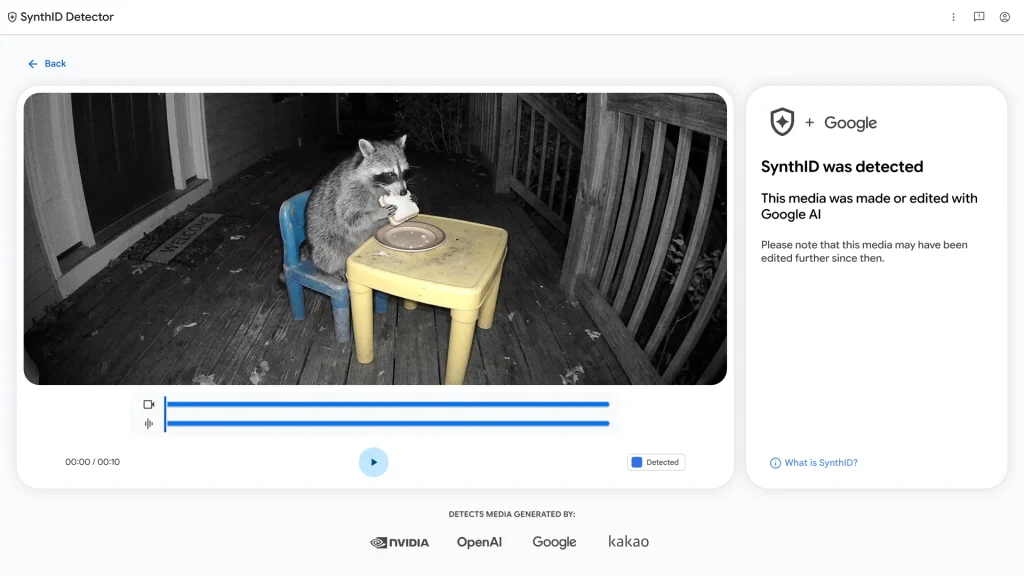
SynthID works by embedding an invisible digital watermark into AI-generated content. The watermark is designed to remain detectable even after common changes such as compression, cropping, filtering or adjustments to video and audio.
The new detector searches uploaded files for these signals. If a supported watermark is found, users can get an indication that the media was generated or modified using a participating AI system.
Google says SynthID has already been used to watermark more than 180 billion images and videos, along with approximately 240,000 years of audio content.
OpenAI, NVIDIA and Kakao Support SynthID
The latest expansion is notable because SynthID is no longer limited to Google’s own AI ecosystem. The public detector can identify supported media from Google and partners including OpenAI, NVIDIA and Kakao. Google says Apple support is also coming soon.
OpenAI has already incorporated SynthID into supported AI-generated images and audio, alongside other provenance technologies such as C2PA Content Credentials. OpenAI also provides its own verification tool for supported content.
This broader compatibility could make provenance checks more useful as users increasingly encounter AI-generated material from different platforms.
A Missing Watermark Does Not Mean Human-Made
There is an important limitation to understand. SynthID is not a universal AI detector.
If the detector does not find a SynthID watermark, that does not prove that a file was created by a human. It may simply mean the content was generated by an unsupported AI system or that the relevant provenance signal is no longer available.
Google’s technology is specifically designed to detect supported SynthID signals, rather than determine the origin of every piece of media on the internet.
That distinction will become increasingly important as AI-generated content spreads across social media, messaging platforms and websites.
AI Verification Is Becoming More Accessible
Google has also integrated AI-content verification into Gemini, Search and Chrome. The company says these verification features are already handling more than one million requests per day.
The public SynthID Detector adds another option for people who want to check a downloaded file directly.
The timing is significant. Generative AI can now produce highly realistic photographs, videos, voices and music, making traditional methods of spotting synthetic content increasingly unreliable.
By moving watermark verification into a publicly accessible tool, Google is effectively giving users another way to investigate suspicious media before sharing or believing it.
Why SynthID Matters
The biggest value of SynthID is not necessarily that it can identify every AI-generated file. Instead, it provides a provenance signal that can help establish whether supported AI systems were involved in creating or editing media.
Google is also working with broader industry standards such as C2PA Content Credentials, which can provide information about a file’s origin and editing history. Unlike SynthID’s embedded watermark, Content Credentials function more like a digital record attached to the media.
Together, these technologies could become increasingly important as the internet fills with synthetic media.
For users, the message is simple: when a photo, video or audio clip looks suspicious, there are now more ways to check its provenance. SynthID will not solve the AI misinformation problem on its own, but opening the detector to everyone gives the public a useful new layer of verification.