

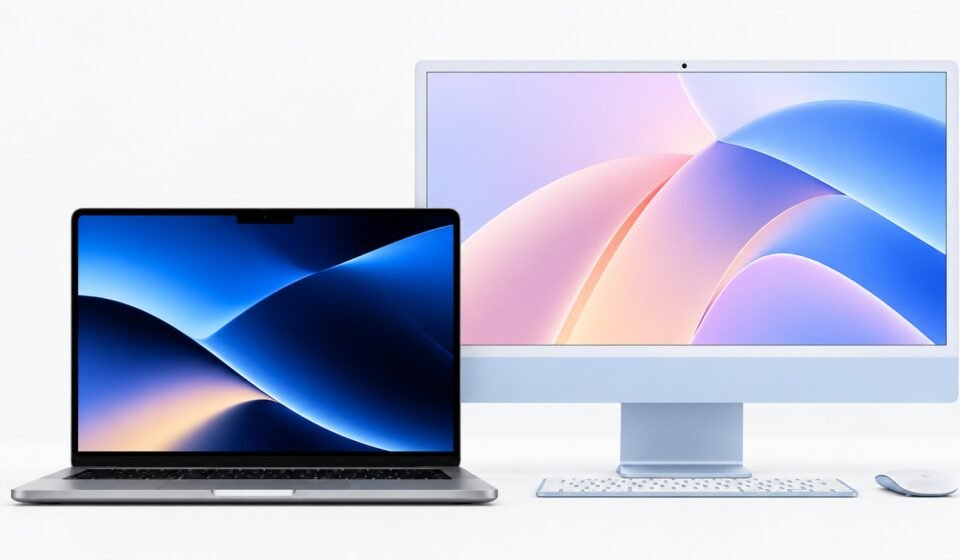
Apple Updates 14-inch MacBook Pro and iMac With M6 Chip: Price in India, Features and Specifications

Apple has refreshed its 14-inch MacBook Pro and 24-inch iMac with the new M6 chip, bringing improved processing power, faster graphics and enhanced AI capabilities to its laptop and desktop lineup. The updates also introduce Wi-Fi 7 and Bluetooth 6 connectivity, while the MacBook Pro promises up to 24 hours of battery life.
The new MacBook Pro is aimed at professionals, students, developers and content creators who need a powerful portable computer. Meanwhile, the updated iMac continues Apple’s all-in-one desktop approach, combining the computer, display and speakers in a slim design available in seven colours.
Both products run macOS 27 and support Apple’s latest Apple Intelligence features. For Indian buyers, the new MacBook Pro starts at Rs. 2,39,900, while the iMac is priced from Rs. 1,74,900.
Apple MacBook Pro M6 and iMac M6 Price in India
Apple has announced the following starting prices for its latest Mac computers in India.
- 14-inch MacBook Pro with M6: Rs. 2,39,900
- iMac with M6, 10-core CPU and 10-core GPU: Rs. 1,74,900
- iMac with M6, 12-core CPU and 12-core GPU: Rs. 1,99,900
Eligible education customers can purchase the MacBook Pro at Rs. 2,27,900. The education price for the base iMac is Rs. 1,68,900, while the higher-performance model costs Rs. 1,87,900.
Pre-orders for both products opened on October 28, 2026, with availability scheduled to begin on November 6 through Apple’s online store, Apple Store locations and authorised resellers.
The MacBook Pro is offered in Space Black and Silver. The iMac is available in Blue, Green, Pink, Yellow, Purple, Orange and Silver.
Apple M6 Chip Brings Faster Performance
The M6 chip is the main upgrade across both computers. Apple says the new processor delivers improvements in CPU performance, graphics processing and AI workloads compared with the previous generation.
The 14-inch MacBook Pro features a 12-core CPU and a 12-core GPU with dedicated Neural Accelerators in each GPU core. It also includes a dual 16-core Neural Engine designed to accelerate machine learning tasks and on-device AI processing.

According to Apple, the M6 GPU delivers up to 30% faster graphics performance than the M5, while on-device AI workloads can run up to 25% faster. These improvements could benefit users working with video editing, 3D rendering, image processing, software development and local AI models.
The iMac also benefits from the new processor. Its entry-level configuration features a 10-core CPU and 10-core GPU, while the higher-end variant includes a 12-core CPU and 12-core GPU.
Apple claims the updated iMac offers up to twice the graphics performance of the previous M4 model in supported workloads. The improved Neural Engine and higher memory bandwidth are also intended to make AI applications and demanding creative tasks more responsive.
Actual performance will depend on the application, configuration and workload.
MacBook Pro M6 Specifications and Features
The new 14-inch MacBook Pro retains Apple’s Liquid Retina XDR display rather than adopting the OLED touchscreen technology discussed in separate MacBook Pro reports.
The display supports up to 1,600 nits of peak HDR brightness and a contrast ratio of 1,000,000:1. An optional nano-texture finish is available for users who frequently work in bright environments and want to reduce reflections.
The laptop starts with 16GB of unified memory, with configurations available up to 32GB. Storage begins at 1TB, with 2TB and 4TB options available.
Apple also claims battery life of up to 24 hours, although actual endurance will depend on screen brightness, applications, wireless connectivity and other usage conditions.
Other features include a 12MP Center Stage camera, a six-speaker sound system, studio-quality microphones, MagSafe 3 charging, HDMI, an SDXC card slot and three Thunderbolt 4 ports.
The M6 model also supports Wi-Fi 7 and Bluetooth 6. These upgrades are intended to improve wireless performance and provide faster connectivity with compatible routers and accessories.
For professionals who regularly work away from a desk, the combination of a portable design, high-performance processor and extended battery life could make the MacBook Pro an appealing option.
iMac M6 Features a 24-inch 4.5K Retina Display
The updated iMac retains its familiar slim all-in-one design and 24-inch Retina display with 4.5K resolution and 500 nits of brightness.

The display supports the P3 wide colour gamut and more than one billion colours, making it suitable for everyday productivity, photo editing, presentations and creative projects.
Apple has retained the colourful design, offering seven finishes to suit different workspaces and home setups.
The iMac’s camera and audio systems are also important parts of the package. It includes a 12MP Center Stage camera for video calls, a three-microphone array and speakers with support for Spatial Audio and Dolby Atmos.
The computer comes with colour-matched accessories, including a keyboard and a mouse or trackpad. Touch ID is available through compatible Magic Keyboard configurations, with the higher-end model including it as standard.
The optional nano-texture display finish is available on the higher-end configuration.
Memory, Storage and Connectivity
The base MacBook Pro M6 configuration includes 16GB of unified memory and 1TB of SSD storage. Buyers can configure the laptop with up to 32GB of memory and 4TB of storage, depending on their needs.
The iMac also starts with 16GB of unified memory. The entry-level model supports configurations with up to 24GB, while the higher-end variant can be configured with up to 32GB.
Storage starts at 256GB on the iMac, with 512GB and 1TB options available for both models. The higher-end configuration also offers a 2TB option.
Apple says the updated iMac offers up to twice the SSD read and write performance of the previous generation. This could help applications launch faster and reduce waiting times when working with large files.
Connectivity includes Wi-Fi 7 and Bluetooth 6 on both computers. The iMac also offers up to four Thunderbolt 4 ports on the higher-end model and optional 2.5 Gigabit Ethernet, providing additional flexibility for demanding workflows and wired networks.
macOS 27 Adds New AI Features
Both computers run macOS 27, which brings Apple’s latest software features and Apple Intelligence capabilities to the Mac.
The software includes Siri AI, designed to provide more conversational assistance and help users find information across supported applications. Apple Intelligence also adds capabilities to everyday tools, including writing assistance, image editing and automation through Shortcuts.
The operating system introduces refinements to the Liquid Glass interface and additional personalisation controls.
Availability of individual AI features depends on the supported language, region and software version. Some capabilities may also be introduced through later software updates.
Should You Buy the New MacBook Pro or iMac?
The choice between the two updated Macs depends largely on how you work.
The MacBook Pro M6 is the better fit for users who need portability, high performance and long battery life. Its 14-inch display, configurable memory and storage, and broad range of ports make it suitable for developers, designers and professionals who work across different locations.
The iMac M6 is better suited to users who prefer a desktop setup with a large display, integrated speakers and a clean workspace. Its seven colour options and all-in-one design make it appealing for homes, studios, offices and small businesses.
At Rs. 2,39,900, the MacBook Pro sits firmly in the premium laptop category. The iMac’s Rs. 1,74,900 starting price may be more attractive to users who do not need a portable computer.
Overall, Apple’s M6 refresh focuses on faster performance, better AI capabilities and improved connectivity rather than a complete redesign. For Indian buyers considering a new Mac, the updated MacBook Pro and iMac offer two different ways to access Apple’s latest computing platform.


