
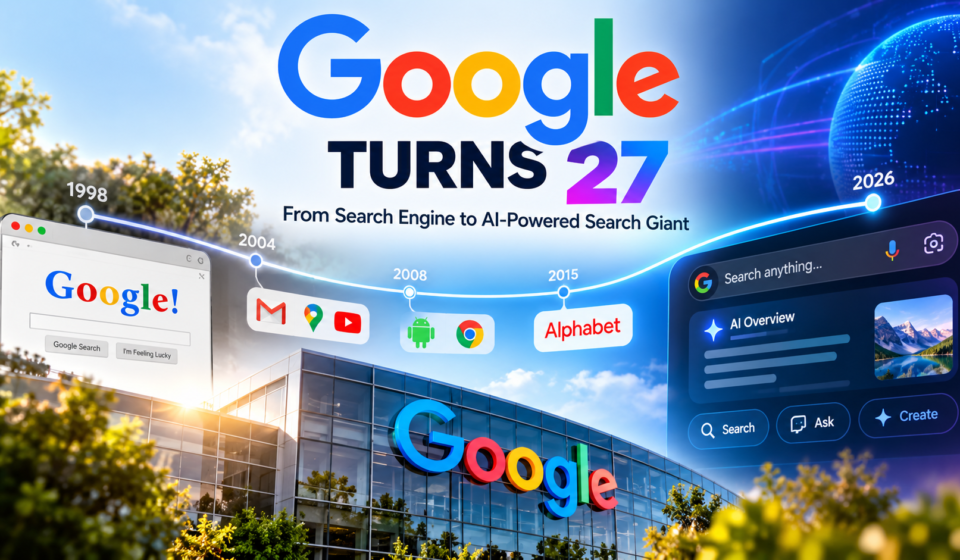

Google has spent 27 years transforming the way people find information online. What began as a search engine built around ranking web pages has grown into a vast technology ecosystem spanning Search, YouTube, Android, Maps, Gmail, Chrome, Cloud and artificial intelligence.
Google officially marks its anniversary on September 27, although the company was incorporated on September 4, 1998. The September 27 date became the company’s traditional birthday, and in 2025 Google celebrated its 27th anniversary with a nostalgic Doodle featuring its original 1998 logo.
The anniversary offers a useful look at how Google’s core Search product has evolved from a list of links into an increasingly AI-powered platform.
From BackRub to Google Search
Google’s story began at Stanford University, where Larry Page and Sergey Brin worked on a research project that initially became known as BackRub.
The project used links between websites as an important signal for determining the relevance and importance of web pages. This approach helped Google produce more useful search results at a time when finding information online could be difficult.
Google was incorporated in 1998 and quickly expanded beyond its original search technology. Its clean homepage and emphasis on relevant results helped it become a dominant destination for web searches.
The company’s mission has remained centered on organising information and making it accessible and useful.
How Google Expanded Beyond Search
Google’s growth eventually went far beyond its original search engine.
The company launched products and services including Gmail, Google Maps, Android, Chrome, Google Photos and Google Drive, creating an ecosystem that connects search, communication, mobile devices and productivity.
YouTube, acquired by Google in 2006, also became a major part of the company’s internet presence.
In 2015, Google became a subsidiary of Alphabet, allowing the company to separate its core Google operations from a number of longer-term projects and businesses.
Search remained Google’s central product, but the company increasingly invested in cloud computing, hardware and artificial intelligence.
Google’s Shift Toward Artificial Intelligence
The biggest change in Google’s recent history has been the move toward AI.
Google has described itself as an AI-first company for a decade, and artificial intelligence is now being integrated directly into Search rather than existing only as a separate product.
At Google I/O 2026, CEO Sundar Pichai said AI Overviews had surpassed 2.5 billion monthly active users, while AI Mode had passed 1 billion monthly active users. Google also said AI Mode queries had more than doubled every quarter since launch.
This represents a major change in how Google expects people to interact with Search.
Instead of entering a few keywords and opening several webpages, users can increasingly ask longer, conversational questions and continue the interaction with follow-up requests.
AI Mode Is Changing Google Search
Google’s AI Mode is one of the company’s biggest changes to Search in decades.
In May 2026, Google announced a major expansion of AI Mode using Gemini 3.5 Flash as the default model globally. The company also redesigned the Search box to make it easier for users to enter longer and more detailed questions.
Google has also been adding capabilities that allow Search to perform tasks rather than simply provide information.
These include agentic features for shopping, booking and other services. Google has said users will increasingly be able to describe what they need and allow Search to help complete the next steps.
Search Is Becoming More Agentic
Google’s current direction goes beyond AI-generated answers.
At I/O 2026, the company introduced information agents that can work in the background to find information for users. Google also discussed agentic coding capabilities and the ability to create more personalized experiences directly inside Search.
This represents a significant shift from the traditional search model.
The old workflow was simple: search, click and read.
The emerging model is closer to: ask, understand, research and act.
Google is also adding connected applications to AI Mode. In July 2026, the company announced that users would be able to connect services and interact with them directly inside Search, including applications for shopping, music and design.
Gemini Is Now Central to Google’s AI Strategy
Google’s Gemini models are playing a major role in this transition.
Gemini is no longer limited to a standalone chatbot. Google is integrating its models across Search, Workspace, Android and other products.
The company also launched Gemini Spark, an AI agent designed to handle recurring tasks in the background. In India, Google announced its expansion to Google AI Pro subscribers in July 2026.
The broader strategy is to make AI an interface for Google’s ecosystem rather than simply another destination users visit.
From Ten Blue Links to AI Answers
Google’s transformation is particularly visible in the Search results page.
The traditional Google experience was built around a list of webpages, advertisements and other search features. AI Overviews and AI Mode now place generated responses much closer to the beginning of the search experience.
However, Google continues to include links to supporting webpages. Its 2026 Search updates describe AI Search as combining AI answers with access to the wider web.
For publishers and website owners, this change is significant because users may increasingly discover information through AI-generated summaries before deciding which links to open.
What Comes Next for Google?
Google’s next phase is likely to be defined by the combination of Search, Gemini and AI agents.
The company is increasingly building systems that can understand text, images, files and other forms of information while taking actions on a user’s behalf.
Google’s 2026 announcements also show that the company is connecting AI to external applications and services, allowing users to complete more tasks without switching between multiple websites or apps.
After 27 years, Google’s original search box remains familiar, but what happens after a user presses Search is changing rapidly.
Final Thoughts
Google’s journey from a Stanford research project to one of the world’s largest technology companies has been closely tied to the evolution of Search.
The company began by helping users find webpages. It then expanded into email, maps, mobile operating systems, video, browsers and cloud computing.
Now, artificial intelligence is becoming the next major layer.
With AI Overviews, AI Mode, Gemini, connected apps and agentic capabilities, Google is moving toward a Search experience that can understand more complex requests and help users complete tasks.
The company’s 27th anniversary therefore represents more than a celebration of its history. It also highlights how dramatically the definition of “search” is changing as Google moves from finding information toward helping users understand and act on it.