

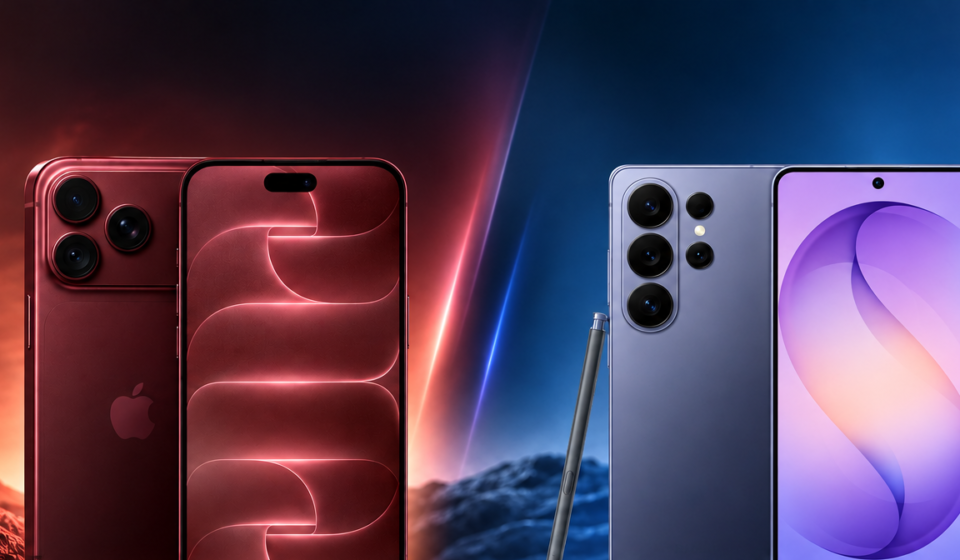

The Apple iPhone 18 Pro and Samsung Galaxy S26 Ultra represent two different approaches to the premium smartphone. Apple is pushing the iPhone further into pro-level photography, on-device AI and sustained performance, while Samsung continues to combine a large display, versatile cameras, S Pen functionality and Galaxy AI.
Both phones are positioned at the top end of the 2026 flagship market. Recent flagship-phone roundups have highlighted both the iPhone 18 Pro and Galaxy S26 Ultra among the major premium smartphones of the year.
So how do Apple and Samsung compare when you look beyond the brand names? Here is a detailed breakdown of their displays, processors, cameras, battery life, software and everyday features.
Apple iPhone 18 Pro vs Samsung Galaxy S26 Ultra: Specifications
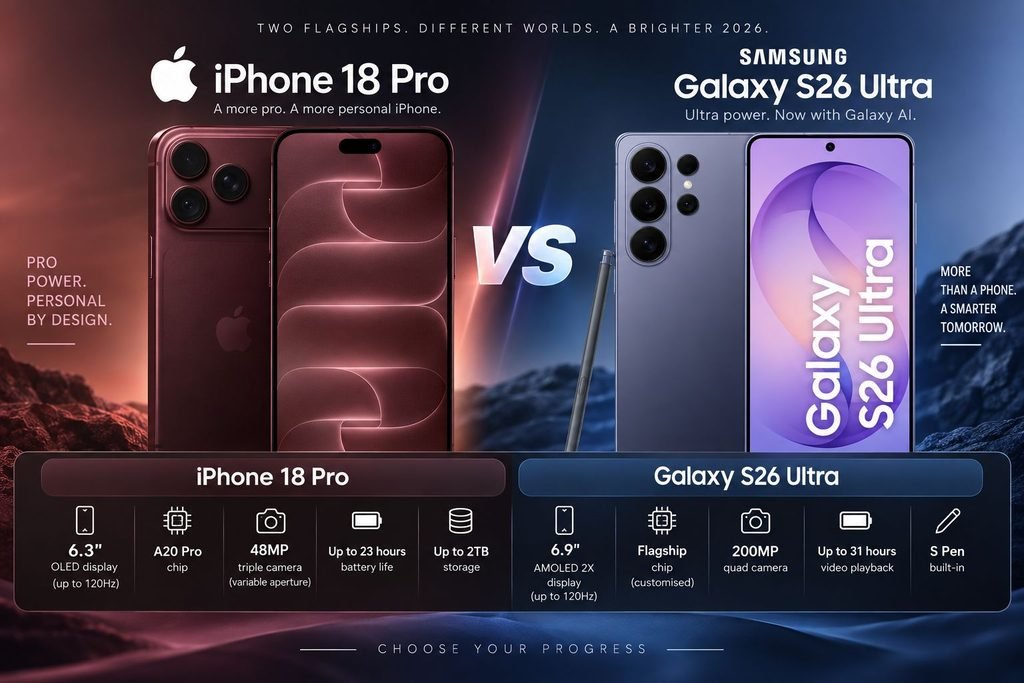
| Feature | Apple iPhone 18 Pro | Samsung Galaxy S26 Ultra |
| Display | 6.3-inch OLED | 6.9-inch display |
| Refresh rate | Up to 120Hz | Up to 120Hz |
| Processor | A20 Pro | Customized flagship processor |
| Main camera | 48MP variable aperture | 200MP |
| Ultra-wide | 48MP | 50MP |
| Telephoto | 48MP 4x | 50MP 5x + 10MP 3x |
| Front camera | 18MP Center Stage | 12MP |
| Storage | Up to 2TB | Up to 1TB |
| Battery | Up to 23 hours typical use | Up to 31 hours video playback |
| Charging | USB-C, MagSafe up to 25W | Up to 75% in around 30 minutes |
| Connectivity | 5G, Wi-Fi 7, Bluetooth 6 | 5G, Wi-Fi 7 |
| Stylus | No | S Pen |
| OS | iOS 27 | Android with One UI |
Apple’s specifications confirm that the iPhone 18 Pro offers storage options from 256GB through 2TB, while Samsung emphasizes its large display, multi-camera setup and integrated S Pen experience.
Design and Display
The biggest physical difference is immediately obvious.
The iPhone 18 Pro has a 6.3-inch Super Retina XDR OLED display. It supports ProMotion with adaptive refresh rates up to 120Hz, Always-On functionality and a peak outdoor brightness of 3,000 nits. The phone uses an aluminium unibody design with Ceramic Shield 2 on the front and Ceramic Shield on the back.
Samsung takes the larger-screen route. The Galaxy S26 Ultra has a 6.9-inch display and weighs 214 grams, with a body measuring 7.9mm thick.
That difference matters in daily use. The iPhone 18 Pro is the more compact device, while the Galaxy S26 Ultra gives users considerably more screen real estate for video, gaming, document editing and multitasking.
Samsung’s S Pen is another major distinction. It turns the Galaxy S26 Ultra into more than a conventional touchscreen phone, particularly for handwritten notes, annotations and precision interaction.
Performance: A20 Pro vs Samsung’s Flagship Chip
Apple has equipped the iPhone 18 Pro with its A20 Pro chip.
The processor uses a six-core CPU, seven-core GPU with Neural Accelerators and a dual 16-core Neural Engine. Apple has also added a next-generation vapour chamber designed to help the phone maintain performance during demanding workloads.
Independent testing reported by Tom’s Guide found significant performance gains from the A20 Pro generation, with the iPhone 18 Pro models achieving very strong CPU and graphics benchmark results.
Samsung uses a customized flagship processor with improvements to its CPU, GPU and NPU. Samsung’s emphasis is particularly strong on AI processing, photography and Galaxy AI features.
For everyday tasks, both platforms have more than enough performance. The differences become more relevant for demanding gaming, video editing, AI workloads and long periods of sustained processing.
Camera Comparison
Camera hardware is one of the most interesting differences between the two phones.
iPhone 18 Pro Cameras
Apple has equipped the iPhone 18 Pro with a 48MP Pro Fusion camera system.
The main 48MP Fusion camera introduces a variable aperture, with four settings ranging from f/1.48 to f/4.0. This gives photographers more control over exposure and depth of field. The phone also includes a 48MP ultra-wide camera and a 48MP telephoto camera with 4x optical zoom.
Apple also adds Pro controls for aperture, shutter speed, white balance and histogram viewing.
Video remains an important part of the iPhone’s camera proposition. The iPhone 18 Pro supports 4K Dolby Vision recording, ProRes, ProRes RAW and Apple Log 2.
Galaxy S26 Ultra Cameras
Samsung takes a more specification-heavy approach.
The Galaxy S26 Ultra features:
- 200MP wide camera with f/1.4 aperture
- 50MP ultra-wide camera
- 50MP telephoto with 5x optical zoom
- 10MP telephoto with 3x optical zoom
Samsung says the wider aperture on the 200MP main camera improves brightness, while its Nightography system is designed to reduce noise in low-light video.
The extra telephoto camera gives Samsung a particularly flexible multi-camera setup, with both 3x and 5x optical zoom options.
Apple vs Samsung: Camera Philosophy
The difference is less about megapixel numbers and more about how each company approaches photography.
Apple’s iPhone 18 Pro combines 48MP sensors with computational photography, manual controls and a variable-aperture main lens. It is also heavily focused on professional video features.
Samsung gives users a broader selection of focal lengths, including dedicated 3x and 5x telephoto cameras. The 200MP main sensor and Nightography features are designed to deliver flexibility across different lighting conditions.
For someone who regularly switches between standard, ultra-wide and zoom photography, the Galaxy’s camera hardware offers several dedicated focal lengths. Someone focused on video production and manual camera controls may place greater importance on Apple’s Pro video tools.
Battery Life and Charging
Battery specifications are another area where Apple and Samsung take different approaches.
Apple rates the iPhone 18 Pro for up to 23 hours of typical use, with up to 34 hours of video playback. The larger iPhone 18 Pro Max goes further, but that is a separate model.
Samsung lists up to 31 hours of video playback for the Galaxy S26 Ultra. It can also reach approximately 75 percent charge in around 30 minutes under Samsung’s stated charging conditions.
The charging comparison is particularly relevant for heavy users. Samsung’s faster charging approach can reduce the time the phone needs to remain connected to a charger.
Apple supports MagSafe and Qi2 wireless charging up to 25W, alongside USB-C wired charging.
AI Features: Apple Intelligence vs Galaxy AI
AI has become a central part of both smartphones.
The iPhone 18 Pro introduces an updated Apple Intelligence experience, including Siri AI. Apple describes the new Siri as more personal and conversational, with integration across apps.
Samsung’s Galaxy S26 Ultra places Galaxy AI directly into features such as Photo Assist. Samsung says users can describe edits using natural-language prompts, with Galaxy AI applying the requested changes.
This means the two platforms are increasingly similar in their ambition, but different in implementation. Apple integrates AI closely with iOS and its ecosystem, while Samsung places substantial emphasis on AI-powered productivity, image editing and Android customization.
Storage Options
Apple has an unusually broad storage range for the iPhone 18 Pro.
Configurations start at 256GB and extend through 512GB, 1TB and 2TB.
Samsung’s Galaxy S26 Ultra also targets heavy users with large storage options, although its maximum capacity is lower than Apple’s 2TB configuration.
For people who record large amounts of 4K video or keep extensive offline media libraries, storage can become an important consideration.
Software and Ecosystem
The iPhone 18 Pro runs iOS 27, giving it direct access to Apple’s ecosystem of Macs, iPads, Apple Watch, AirPods and other services.
The Galaxy S26 Ultra runs Samsung’s Android-based software environment and integrates with the wider Galaxy ecosystem. Its S Pen also creates a productivity workflow that Apple’s iPhone does not directly replicate.
The choice here is less about specifications and more about existing devices. Someone already invested in Apple’s ecosystem may value continuity between devices, while Galaxy users can take advantage of Samsung’s Android, Galaxy AI and S Pen features.
Apple iPhone 18 Pro vs Samsung Galaxy S26 Ultra: Which One Fits You?
There is no single specification that settles this comparison.
The iPhone 18 Pro focuses on a relatively compact premium design, the A20 Pro processor, variable-aperture photography, advanced video recording and Apple’s integrated software ecosystem. It also offers up to 2TB of storage.
The Galaxy S26 Ultra takes a different route with a much larger display, 200MP main camera, multiple dedicated telephoto cameras, S Pen support, Galaxy AI and fast charging.
The right fit therefore depends on what you prioritize. Compact size, iOS integration and professional video tools point toward Apple’s approach. A large screen, stylus support, extensive zoom hardware and Android customization point toward Samsung’s approach.
Final Take
The Apple iPhone 18 Pro vs Samsung Galaxy S26 Ultra comparison shows how differently two flagship platforms can approach the same premium smartphone market.
Apple has concentrated on the A20 Pro platform, variable-aperture photography, video capabilities, AI and ecosystem integration. Samsung has combined a large display with a high-resolution camera system, multiple telephoto lenses, Galaxy AI and S Pen functionality.
Both are built for demanding users, but they prioritize different experiences. The decision ultimately comes down to the software ecosystem and features that matter most in your daily use, rather than simply choosing the phone with the biggest number on a specification sheet.
Apple iPhone 18 Pro technical specifications for official display, processor, camera, storage, battery and connectivity information.
Samsung Galaxy S26 Ultra official product page for official camera, display, battery and Galaxy AI specifications.