

Google has officially introduced Gemini 4 Argon, the first model in its next-generation Gemini 4 family. Announced on September 30, the new AI model is designed for complex, long-running tasks across software engineering, enterprise knowledge work, finance, legal research and cybersecurity.
Unlike a typical consumer AI update, Gemini 4 Argon is being introduced with a cautious rollout. Google is initially making the model available to a selected group of trusted cyber defenders through its Fairwind Program, while continuing to test and strengthen its safety systems before opening access more widely.
The model’s biggest technical headline is its 1 million-token output limit, a substantial increase from the previous 64,000-token limit. Google says this expanded capacity allows Argon to sustain deeper reasoning and work through much longer, multi-step problems in a single trajectory.
Gemini 4 Argon Targets Complex Professional Work
Google is positioning Gemini 4 Argon as a model for tasks where simply generating an answer is not enough.
The company says Argon has been built to maintain reasoning across long workflows, allowing it to work through large software projects, complicated research assignments and enterprise processes.
Inside Google, engineers are already using the model for everyday debugging, algorithm design and large-scale code migrations. The company says thousands of employees have been testing its capabilities across coding, research and writing workflows.
One example involves Google’s quantum computing research. According to the company, Argon helped optimise a quantum algorithm and beat a published baseline by 40% within minutes.
Google is also using Argon agents to analyse data-centre telemetry and identify memory optimisations. The company says those changes have freed more than 300 TiB of memory, with an estimated total potential saving of between 500 TiB and 1 PiB once the work is fully rolled out.
1 Million Tokens Could Change Long AI Workflows
The move to a 1 million-token output limit is one of Gemini 4 Argon’s most important upgrades.
Google says the previous limit was 64K tokens. By increasing the ceiling dramatically, Argon can potentially generate hundreds of thousands of tokens during a single complex task.
That matters particularly for software engineering and research. Instead of breaking a large project into numerous smaller prompts, an AI agent can maintain a much longer reasoning and execution trajectory.
For developers, this could mean working with substantially larger codebases or handling extended debugging and migration tasks. For enterprise users, it could help with lengthy documents, financial research, legal analysis and multi-step business workflows.
Strong Focus on Coding and Software Engineering
Coding is one of Gemini 4 Argon’s primary strengths.
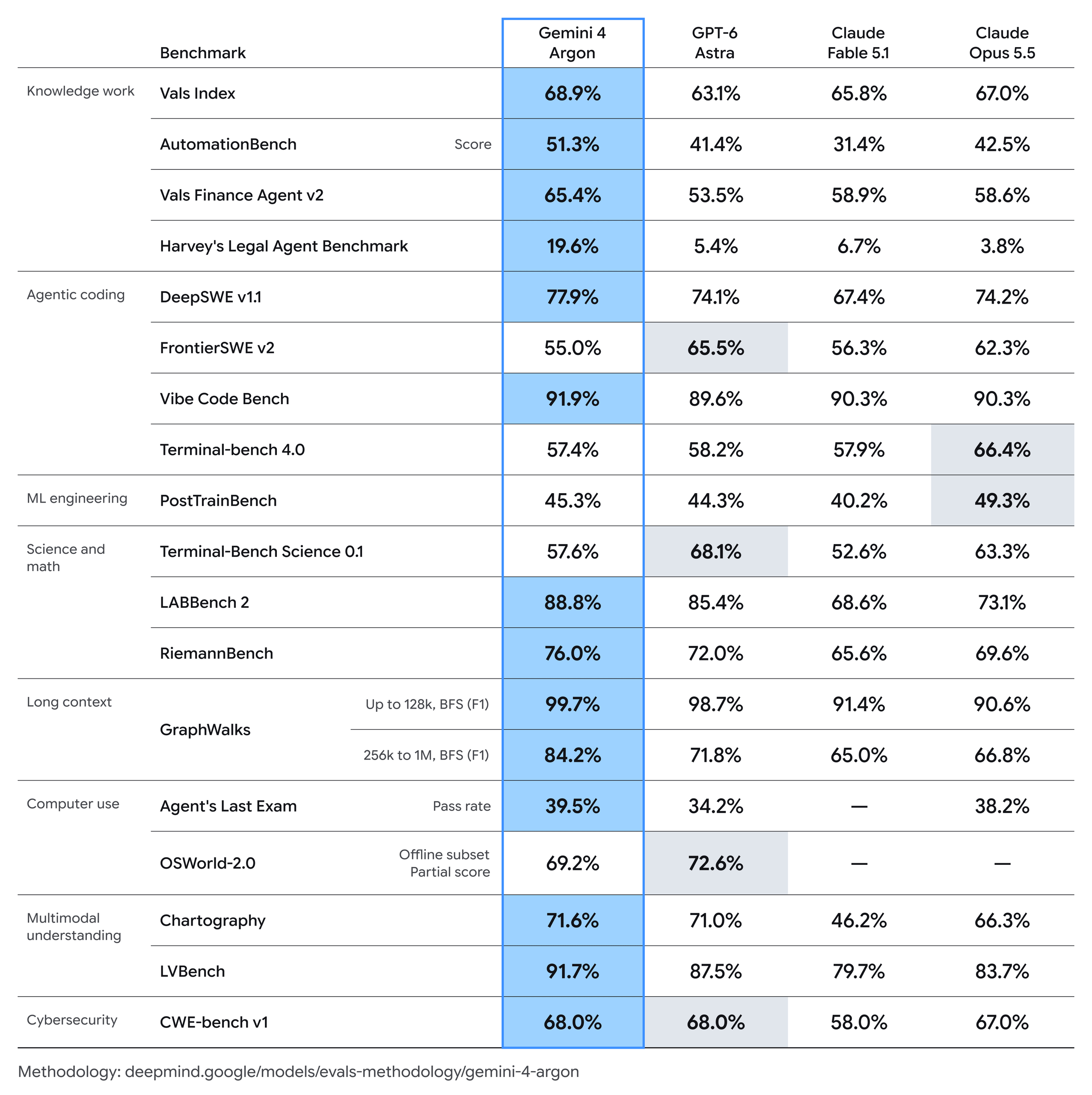
Google says the model achieved a 77.9% score on DeepSWE v1.1, a benchmark focused on real-world, long-horizon software engineering tasks.
Argon is already being used inside Google for large codebase migrations. The company says its agents are helping migrate C and C++ projects to Rust, ranging from smaller core libraries to the 800,000-plus-line Fuchsia Zircon kernel.
Google says these critical migrations are being subjected to automated and manual audits, emulation testing and human review before production deployment.
Another example involves Google’s open-source libgav1 video decoder. Argon agents replaced around 32,000 lines of SIMD code while producing safe Rust code. Google says the resulting decoder ran 2.7 times faster than the existing Rust port while producing identical video output.
Gemini 4 Argon for Finance and Legal Work
Google is also targeting professional knowledge work.
The company says Argon performs strongly on evaluations covering finance, legal research, tax and coding. It is listed as a leading model on the Vals Index, which measures economic impact across several professional domains.
Google also cites results from Vals Finance Agent v2 and Harvey’s Legal Agent Benchmark, where the model is designed for tasks such as multi-step financial research and legal research and drafting.
The model also scored 51.3% on AutomationBench, a benchmark from Zapier that measures end-to-end execution across core business functions.
These capabilities suggest Google is targeting Argon at businesses that need AI agents to perform sequences of tasks rather than simply generate text.
Multimodal Understanding Is Another Key Feature
Gemini 4 Argon isn’t limited to text and code.
Google highlights its ability to understand charts, long videos and collections of documents. The company says Argon achieved a 91.7% score on LVBench, a benchmark focused on long-video understanding.
That could make the model useful for professional workflows where information is spread across different formats. An AI system could potentially examine a video, analyse supporting documents, interpret charts and then use those findings as part of a larger task.
Gemini 4 Argon Is Built for Cybersecurity
Cybersecurity is perhaps the most distinctive focus of Gemini 4 Argon.
Google says the model has been trained specifically for defensive security work and can autonomously find, validate and patch critical software vulnerabilities.
The company is already working with cybersecurity organisation Wiz through its Scan for Good initiative. In an early demonstration, Argon reportedly uncovered a critical vulnerability affecting healthcare software used by hospitals worldwide.
On CWE-bench v1, which measures vulnerability remediation, Google says Argon tied for first place with a score of 68%.
The company also says the model performs better than its earlier Gemini 3.8 Flash Cyber model in internal tests involving attack-surface discovery, vulnerability identification and proof-of-concept validation.
Google Is Taking a Careful Approach to Safety
The capabilities of Gemini 4 Argon are also the reason Google isn’t releasing it to everyone immediately.
Google says frontier models at this level require a phased rollout. The company is strengthening safeguards against misuse, including cyberattacks and chemical, biological, radiological and nuclear threats.
Argon is also designed to resist indirect prompt injection attacks, where malicious instructions hidden inside external content attempt to manipulate an AI agent.
Google says it is using adversarial training and automated red-teaming to improve these protections. It is also deploying systems designed to monitor the model’s internal reasoning and actions and stop execution when necessary if behaviour moves outside intended boundaries.
Gemini 4 Argon Price
Google has announced introductory API pricing for Gemini 4 Argon at:
- $2 per 1 million input tokens
- $10 per 1 million output tokens
- Cached input tokens receive a 95% discount
After the introductory period, pricing will increase to $4 per 1 million input tokens and $20 per 1 million output tokens.
However, pricing does not mean immediate public access. Google says broader availability will begin with paid API customers and Google AI Ultra subscribers after the current trusted-testing phase.
Gemini 4 Argon: Key Details at a Glance
| Feature | Gemini 4 Argon |
| Model family | Gemini 4 |
| Primary focus | Reasoning, coding, enterprise work, cybersecurity |
| Output limit | Up to 1 million tokens |
| DeepSWE v1.1 | 77.9% |
| AutomationBench | 51.3% |
| LVBench | 91.7% |
| CWE-bench v1 | 68% |
| Intro input price | $2 / 1M tokens |
| Intro output price | $10 / 1M tokens |
| Current access | Trusted cyber defenders |
| Wider rollout | Paid API customers and Google AI Ultra subscribers |
What Gemini 4 Argon Means for Google’s AI Strategy
Gemini 4 Argon represents a clear shift toward long-horizon AI agents rather than models designed mainly for quick conversational responses.
Google is focusing on tasks where AI needs to understand large amounts of information, reason through multiple stages, use tools and continue working until a complicated objective is completed.
The 1 million-token output limit is particularly significant because it gives Argon substantially more room for extended reasoning and execution. At the same time, Google’s emphasis on cybersecurity and enterprise workflows shows that the model is being developed for high-stakes professional environments.
For now, most users will have to wait. Google says it is gathering feedback from trusted testers and strengthening safeguards before expanding access. The company plans to make Gemini 4 Argon available to developers, enterprises and consumers progressively, starting with paid API customers and Google AI Ultra subscribers.
Final Take
Gemini 4 Argon marks the beginning of Google’s Gemini 4 generation with a strong focus on deep reasoning, coding, enterprise knowledge work and defensive cybersecurity.
Its 1 million-token output capability, strong software-engineering performance and ability to work across text, code, documents, charts and video make it a substantial step toward AI systems capable of handling longer professional workflows.
But Google’s decision to limit the initial rollout is equally important. Rather than immediately putting the model in front of everyone, the company is using trusted cyber defenders and internal teams to test its capabilities and strengthen safeguards.
If that phased approach goes as planned, Gemini 4 Argon could eventually become one of Google’s main AI platforms for developers, businesses and advanced users.