

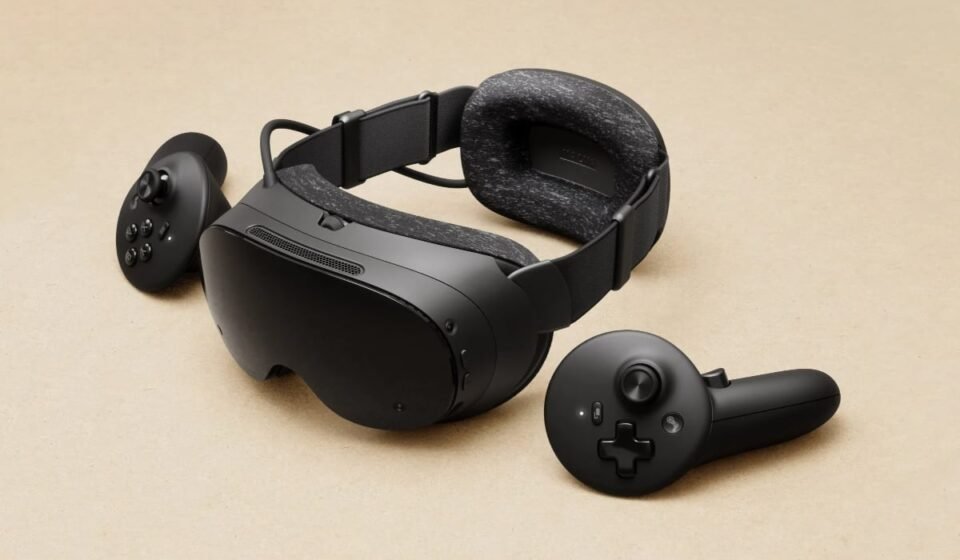

Valve’s Steam Frame has finally reached the point where speculation gives way to a real price tag—and it is considerably more expensive than many VR buyers were hoping.
The Valve’s Steam Frame starts at $1,059 for the 256GB model, while the 1TB version costs $1,299 in the US. Reservations opened on September 14, with Valve using a randomized purchase system rather than a traditional first-come, first-served queue.
That price puts Steam Frame firmly in premium VR territory. But Valve isn’t really positioning it as another Quest-style standalone headset. Its pitch is more ambitious: a lightweight wireless device that can run some games locally, stream demanding PC games and function as a broader SteamOS computer.
Here’s what you need to know.
Valve’s Steam Frame price
Valve has announced two Steam Frame configurations:
| Model | US price | Storage |
| Steam Frame | $1,059 | 256GB |
| Steam Frame | $1,299 | 1TB |
Both versions include the headset, tracked controllers and the wireless adapter. Half-Life: Alyx is also included, with Valve having developed a native ARM64 version that can run directly on the headset.
The pricing is noteworthy because Valve’s previous VR headset, the Valve Index, launched at $999 for the full kit. Steam Frame therefore isn’t the cheaper VR successor some fans expected.
It’s also more expensive than mainstream standalone VR hardware such as Meta’s Quest 3, which changes who the product makes sense for.
Why is Steam Frame so expensive?
The short answer is that Valve is packing considerably more computing and display technology into a device that is designed to operate without a gaming PC.
Valve engineers have pointed to the cost of memory and storage as one reason the final price is higher than earlier expectations. The headset uses a Qualcomm Snapdragon 8 Gen 3 processor and 16GB of RAM, while the base model includes 256GB of storage.
Valve is also attempting something unusual with Steam Frame: it needs to handle both conventional PC games streamed from another machine and games running locally on its own ARM-based hardware.
That dual-purpose architecture adds complexity.
Steam Frame is more than a VR headset
The most interesting thing about Steam Frame isn’t necessarily the display or controllers. It’s the software strategy.
The headset runs SteamOS and is designed to support three broad ways of playing:
- Run compatible games locally
- Stream games wirelessly from a gaming PC
- Use the headset as a spatial computing device
The first option is what separates Steam Frame from traditional PCVR headsets. Valve has worked on ARM support and compatibility technology so selected Steam games can run directly on the headset.
The native Half-Life: Alyx port is the clearest demonstration of what Valve is trying to achieve. Rather than requiring a PC to render the game, the ARM version runs on Steam Frame’s Snapdragon hardware.
More demanding games can still be streamed from a PC, allowing Steam Frame to act as a wireless PCVR headset.
Steam Frame specifications
The hardware is surprisingly ambitious for a standalone headset.
The display uses 2160 × 2160 resolution per eye, with pancake lenses and refresh rates ranging from 72Hz up to 144Hz, with 144Hz described as experimental. The headset also incorporates eye tracking for foveated rendering.
Key specifications include:
| Feature | Steam Frame |
| Processor | Qualcomm Snapdragon 8 Gen 3 |
| RAM | 16GB LPDDR5X |
| Base storage | 256GB |
| Premium storage | 1TB |
| Display | 2160 × 2160 per eye |
| Lenses | Pancake |
| Refresh rate | Up to 144Hz |
| Battery | 21.6Wh |
| Connectivity | Wi-Fi 7 |
| Tracking | Inside-out tracking + eye tracking |
The hardware is designed to keep the headset relatively light while moving some of the weight toward the rear-mounted battery. That should make it more comfortable than front-heavy VR hardware, although comfort will ultimately depend on head shape and strap configuration.
Wireless PCVR is a major selling point
For serious PCVR users, Steam Frame’s wireless capabilities could be more important than its standalone performance.
Valve supports wireless game streaming from a PC, while an included 6GHz wireless adapter can provide a dedicated connection. This means you don’t necessarily have to connect the headset to a gaming PC with a conventional video cable.
That’s a compelling proposition for people who already own a powerful gaming PC.
Instead of buying a headset purely for standalone VR, you get a device that can become a wireless window into your existing Steam library.
Half-Life: Alyx is a big deal
Including Half-Life: Alyx is more than a promotional freebie.
Valve’s engineers spent roughly a year bringing the PC VR game to ARM and improving the underlying Vulkan and SteamVR technology required to make it work. The result is a native version designed specifically for Steam Frame’s hardware.
The port also demonstrates the potential of Valve’s approach. If more demanding Steam games can be adapted or translated to run effectively on ARM, Steam Frame could eventually become a much more capable standalone gaming platform.
That said, buyers shouldn’t assume the entire Steam catalogue will suddenly run natively. PC games vary enormously in their hardware requirements and compatibility.
The biggest problem: the price
At $1,059, Steam Frame is difficult to recommend as an impulse VR purchase.
The 256GB model costs more than many people spend on an entire standalone VR setup. The $1,299 1TB model pushes it even further into enthusiast territory.
That doesn’t necessarily make it overpriced. It means Valve is targeting a different customer.
If you already own a capable gaming PC, have a large Steam library and want premium wireless PCVR with standalone capabilities, the calculation looks different.
For someone who simply wants to try VR for the first time, cheaper alternatives make considerably more sense.
How Valve’s reservation system works
Valve isn’t using a conventional launch-day queue.
Reservations opened September 14 and remain open until September 17 at 10:00 a.m. Pacific Time. Valve then randomizes eligible reservations, with the first purchase invitations scheduled to go out from September 18.
That means signing up immediately doesn’t necessarily give you an advantage over someone who joins later during the reservation window.
Valve says the approach is designed to reduce the advantages enjoyed by bots and scalpers.
There are also account and purchasing requirements, including a Steam account in good standing and a previous Steam purchase made before April 27, 2026, according to Valve’s reservation rules.
Should you buy Valve’s Steam Frame?
That depends heavily on what you already own.
Steam Frame makes the most sense for:
- Enthusiast PC gamers
- Existing Steam users with powerful gaming PCs
- PCVR players who want wireless operation
- Buyers interested in standalone SteamOS gaming
- Early adopters interested in ARM gaming
- People willing to pay a premium for new hardware
It’s harder to justify for:
- First-time VR buyers
- Casual gamers
- People without a gaming PC
- Buyers primarily interested in inexpensive standalone VR
- Anyone uncomfortable paying more than $1,000 for experimental hardware
The 256GB model is probably the more sensible option for most enthusiasts. You save $240 compared with the 1TB version, and the headset supports expandable storage through microSD. The 1TB model becomes more attractive if you expect to install a large library of locally playable games.
The bigger picture for Valve
Steam Frame may ultimately matter beyond the VR market.
Valve is clearly experimenting with a broader version of SteamOS that isn’t tied to x86 PCs or the Steam Deck. The Steam Frame’s ARM-based architecture shows that Valve wants Steam to work across more types of hardware.
That’s potentially a bigger story than the headset itself.
If Valve can make Windows PC games, Linux software and VR titles work convincingly across ARM hardware, SteamOS could become a much more flexible platform.
For now, however, Steam Frame remains an expensive enthusiast product.
Bottom line
Valve’s Steam Frame is ambitious, technically interesting and undeniably expensive.
At $1,059 for 256GB and $1,299 for 1TB, it costs significantly more than mainstream standalone VR headsets. But you’re getting something different: a wireless PCVR headset, standalone SteamOS hardware and a spatial computer in one package.
The inclusion of Half-Life: Alyx, the Snapdragon 8 Gen 3 platform, 16GB RAM, high-resolution displays, eye tracking and wireless PC streaming make it one of Valve’s most technically interesting hardware launches.
Whether it’s worth the money comes down to one question: do you want a premium Steam gaming device, or do you simply want a VR headset?
If it’s the latter, cheaper options are easier to recommend. If it’s the former, Steam Frame is shaping up to be one of the most interesting pieces of gaming hardware Valve has released.