



Canon has officially announced the EOS R8 Mark II, turning its lightweight full-frame mirrorless camera into a considerably more capable hybrid shooter.
The new camera keeps the original R8’s 24.2-megapixel full-frame sensor and compact philosophy, but addresses two of its biggest shortcomings: the lack of in-body image stabilization and the absence of an autofocus joystick. It also gets improved subject tracking, longer burst shooting, pre-capture and a redesigned body.
The result is a camera that sits between Canon’s entry-level full-frame models and its more expensive enthusiast bodies without becoming particularly large or heavy.
Canon says the EOS R8 Mark II is expected to arrive in the US in late October 2026, priced at $1,899 for the body or $2,099 with the RF24-50mm F4.5-6.3 IS STM lens.
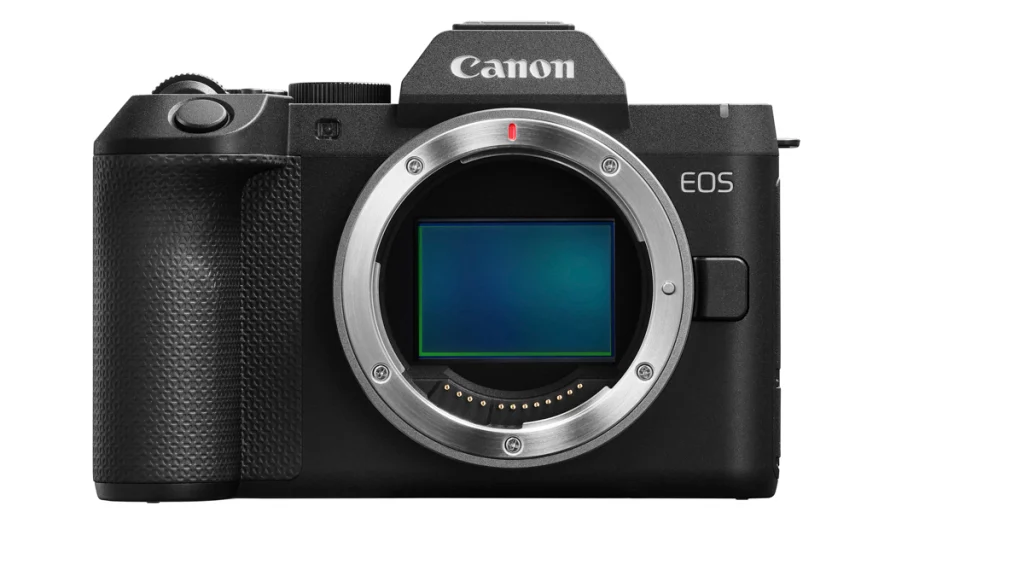
Canon EOS R8 Mark II specifications
| Feature | Canon EOS R8 Mark II |
| Sensor | 24.2MP full-frame CMOS |
| Processor | DIGIC X |
| Stabilisation | 5-axis IBIS, up to 7.5 stops centre |
| Autofocus | Dual Pixel CMOS AF II |
| Continuous shooting | Up to 40fps electronic |
| Pre-capture | Up to 20 frames |
| Video | 6K-oversampled 4K/60p |
| Slow motion | Full HD up to 180p |
| Viewfinder | 2.36-million-dot OLED |
| Screen | 3-inch, 1.62-million-dot vari-angle |
| Storage | 1× UHS-II SD |
| Battery | LP-E17 |
| Weight | 499g body only; 546g with battery/card |
| Mount | Canon RF |
| US price | $1,899 body / $2,099 kit |
Canon’s official specifications confirm the 24.2MP sensor, DIGIC X processor, RF mount, single UHS-II SD slot and compact 499g body-only weight.
The biggest upgrade is IBIS
The original EOS R8 was unusually capable for its size, but it lacked in-body image stabilisation. That was one of the most obvious compromises compared with more expensive Canon cameras.
The EOS R8 Mark II fixes that.
Its five-axis IBIS system provides up to 7.5 stops of correction at the centre and 7 stops at the periphery, depending on the lens and shooting conditions. Canon also supports coordinated control between the camera’s IBIS and compatible lens-based optical stabilisation.
For photographers, this matters most when shooting handheld in low light.
A stabilised sensor can let you use slower shutter speeds without introducing camera shake, although it can’t freeze a moving subject. For travel, street photography, interiors and general everyday shooting, the difference should be much more noticeable than a modest increase in sensor resolution would have been.
DPReview also identifies IBIS as one of the two major improvements over the original R8.
Canon adds the missing autofocus joystick
The other major handling upgrade is the addition of a multi-controller autofocus joystick.
The original R8 required photographers to use the touchscreen or directional controls to reposition the AF point. That’s workable, but a joystick is considerably faster when you’re shooting through the viewfinder.
The EOS R8 Mark II uses Dual Pixel CMOS AF II with recognition for people, animals and vehicles. Canon has also added Register People Priority, allowing the camera to recognise specific people and give them focus priority.
DPReview found the autofocus system generally quick and effective, with reliable eye detection and useful subject-recognition controls. It also notes that the tracking behaviour can occasionally override a photographer’s preferred focus area, something worth understanding when precision matters.
40fps shooting gets more practical
On paper, the R8 Mark II’s 40fps electronic shutter doesn’t represent a speed increase over the original R8.
The improvement is what happens after you start shooting.
Canon says the Mark II offers a 30% increase in uninterrupted RAW shots and a 58% increase in JPEG shots compared with the original model. It also adds pre-continuous shooting, which can record up to 20 frames before the shutter is fully pressed.
DPReview’s testing found the buffer could handle approximately 78 RAW+JPEG shots or 175 JPEG-only frames, making the high-speed mode considerably more useful in real-world shooting.
For wildlife, sports, pets and children, that combination could be more valuable than simply increasing the headline frame rate.
The sensor stays at 24.2MP
Canon hasn’t increased resolution.
The EOS R8 Mark II continues to use a 24.2MP full-frame CMOS sensor, paired with the DIGIC X processor. Canon says standard ISO sensitivity reaches 102,400, with an expanded range up to 204,800.
That may initially sound disappointing in a new camera, but there is a practical reason to appreciate the approach.
Canon is improving the camera around the sensor rather than forcing buyers to trade the R8’s established image quality for a higher-resolution chip.
DPReview describes the sensor as essentially the same unit used by the R8, with the significant change being that Canon has now added stabilisation.
Video remains a strong point
The EOS R8 Mark II can record uncropped 4K at up to 60fps, oversampled from 6K capture. It also supports Full HD recording at up to 180fps for slow-motion footage.
Canon has added several usability improvements rather than radically changing the core video specification.
The camera supports Canon Log 3, HDR PQ and HLG recording, along with LUT support. New slow-and-fast modes make it easier to produce speed-ramped or slow-motion clips without relying entirely on post-production.
DPReview also highlights a new focus-rack function that can automatically move the lens toward its closest focusing distance at a selected speed. That’s a small feature, but it can help creators produce more controlled focus transitions.
The camera retains microphone and headphone connections, USB-C connectivity and micro-HDMI.
A compact body remains the attraction
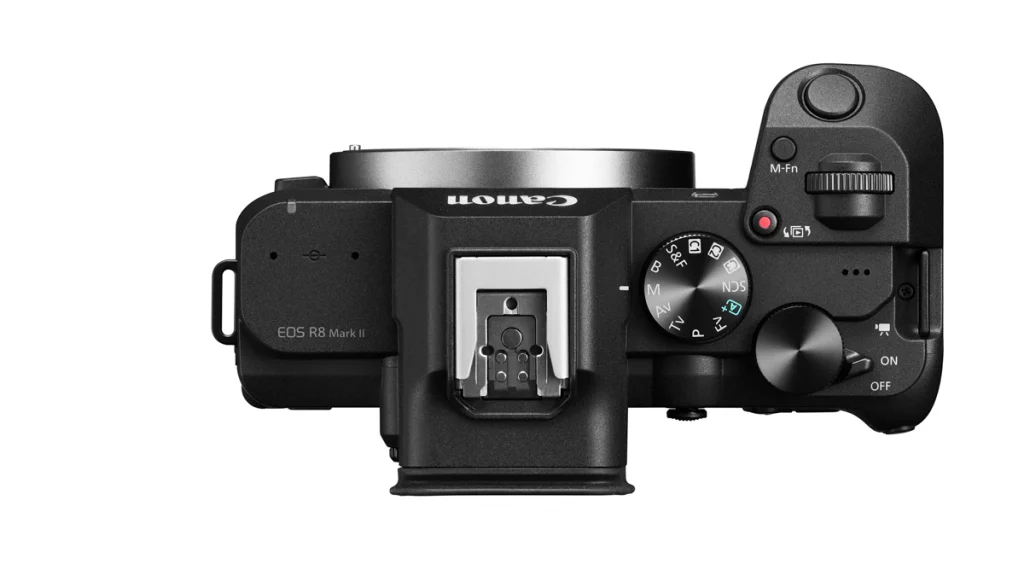
One of the EOS R8’s defining qualities was its size, and Canon hasn’t abandoned that idea.
The R8 Mark II measures approximately 131.4 × 90 × 79.7mm and weighs about 499g without the battery and memory card, or around 546g in a ready-to-shoot configuration. Canon calls it the lightest EOS camera with IBIS.
The body has also been redesigned with a more angular appearance inspired by Canon’s camera heritage.
DPReview describes the new body as compact and comfortable, although photographers with larger hands may still want the optional extension grip.
That optional EG-E2 Extension Grip is priced at $99.99 in the US.
The battery is still a weakness
There’s one notable area where Canon hasn’t made the kind of improvement many users might have wanted: battery life.
The R8 Mark II uses the same LP-E17 battery. Canon rates it for around 270 shots using the rear screen or 150 shots through the EVF under standard CIPA conditions, with power-saving figures reaching approximately 340 and 220 shots respectively.
Real-world battery life can be considerably higher than CIPA numbers, but these figures still make a spare battery or USB power bank a sensible part of the kit.
Adding IBIS without increasing battery capacity also means the camera’s power-management demands deserve attention during long shooting sessions.
One SD card slot remains
The EOS R8 Mark II continues to use one UHS-II SD card slot.
That’s understandable given the camera’s compact design and positioning, but it is still a limitation for professionals who want automatic backup recording or separate photo and video storage.
The card slot has moved to the side of the camera, making it easier to access while the camera is mounted on a tripod.
For enthusiasts, this may not matter. For paid event and wedding photographers, however, dual-card redundancy can be an important consideration.
Canon introduces a new 3D feature
One of the more unexpected announcements is Dual Pixel 3D.
The EOS R8 Mark II can capture JPEG images containing depth information, which can then be processed using Canon’s free Dual Pixel 3D Converter software for Windows. The software can create 3D photos, background-free 3D models and 3D video clips from compatible images.
It’s an unusual feature for a relatively affordable full-frame camera.
Whether photographers will actually build workflows around it remains to be seen, but it gives the R8 Mark II an interesting capability that goes beyond conventional stills and video.
Canon EOS R8 Mark II price and availability
In the US, Canon has announced the following pricing:
- EOS R8 Mark II body: $1,899
- EOS R8 Mark II + RF24-50mm F4.5-6.3 IS STM: $2,099
- EG-E2 Extension Grip: $99.99
- Speedlite EL-5 Ver.2: $379
Canon expects the camera and accessories to become available in late October 2026.
DPReview notes that the $1,899 launch price is about $400 higher than the original R8’s launch price.
Regional pricing and availability can differ, so buyers outside the US should wait for their local Canon announcement rather than converting the US price directly.
Canon EOS R8 Mark II vs EOS R8
The two cameras share a surprising amount of core technology.
Both have a 24.2MP full-frame sensor and 40fps electronic shooting. Both offer 4K/60p video oversampled from 6K and use a 2.36-million-dot EVF.
The Mark II’s meaningful changes are concentrated elsewhere:
| Feature | EOS R8 | EOS R8 Mark II |
| Sensor | 24.2MP full-frame | 24.2MP full-frame |
| IBIS | No | Yes, up to 7.5 stops centre |
| AF joystick | No | Yes |
| Electronic burst | 40fps | 40fps |
| Pre-capture | Raw Burst | Up to 20 frames |
| AF | Dual Pixel CMOS AF | Updated Dual Pixel CMOS AF II |
| Register People Priority | No | Yes |
| Video | 4K/60p | 4K/60p + new tools |
| Card slots | 1 | 1 |
| Battery | LP-E17 | LP-E17 |
In other words, this isn’t a resolution-driven upgrade. It’s about handling, stabilisation, autofocus and sustained performance.
Is the Canon EOS R8 Mark II a major upgrade?
The answer depends on what you expect from a Mark II.
If you’re looking for a dramatic jump in megapixels, dual card slots or a larger battery, the EOS R8 Mark II doesn’t deliver those things.
But Canon has addressed several of the original R8’s most obvious compromises.
IBIS is the headline improvement. The autofocus joystick is arguably just as important for everyday operation. The improved AF algorithms, better buffer and pre-capture make the camera more useful for action, while the new video tools broaden its appeal to creators.
DPReview’s hands-on assessment reaches a similar conclusion: the R8 Mark II retains the compactness that made its predecessor appealing while fixing two of its most significant omissions.
Final verdict
The Canon EOS R8 Mark II is less about chasing headline specifications and more about making a compact full-frame camera easier and more capable to use.
The 24.2MP sensor remains familiar, but Canon has surrounded it with 7.5-stop IBIS, improved autofocus, an AF joystick, 40fps shooting, pre-capture and strong 4K video. The camera also remains remarkably light for a full-frame body with stabilisation.
The compromises are equally clear: a small LP-E17 battery, one SD card slot and a launch price that is considerably higher than the original R8’s.
At $1,899, the EOS R8 Mark II is no longer simply an inexpensive entry into Canon’s full-frame system. It’s a more capable enthusiast camera that happens to remain unusually compact.
For photographers who value portability but don’t want to give up IBIS, modern autofocus and high-speed shooting, that’s a compelling combination.