
Microsoft Announces October 7 Windows and Surface Event: What to Expect
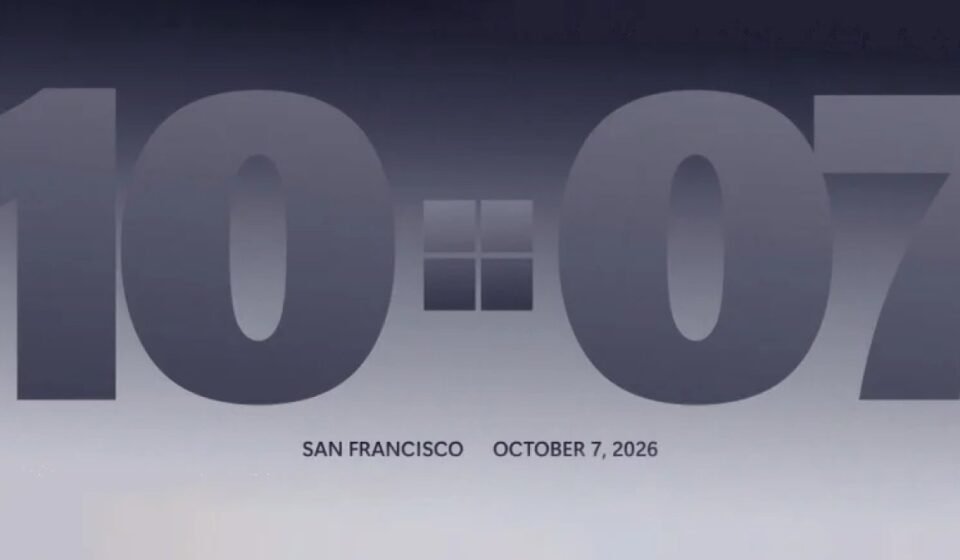
Microsoft is preparing for a major Windows and Surface event on October 7, 2026, in San Francisco, with local artificial intelligence expected to be the central theme. The company says the event will explore “how local AI will shape the next chapter of the PC,” bringing together Windows, Surface hardware, NVIDIA RTX Spark and the broader PC ecosystem.
The event is scheduled for 10 AM PT / 1 PM ET and will feature Microsoft CEO Satya Nadella, Windows and Devices chief Pavan Davuluri and NVIDIA CEO Jensen Huang. Their presence points to a broader discussion about AI-capable PCs rather than a conventional Surface product refresh.
Microsoft October 7 event: What is confirmed?
Microsoft has not provided a detailed product launch list yet. However, the company has confirmed that the presentation will cover developments across Windows, NVIDIA RTX Spark, Surface and the wider PC ecosystem.
That makes the event particularly interesting for anyone following the shift from cloud-based AI toward AI workloads that can run directly on PCs.
Microsoft has already been building the software foundation for this transition. Windows AI APIs support on-device models, NPU acceleration and local inference, while Microsoft Foundry on Windows and Windows ML allow developers to run AI workloads locally on compatible hardware.
The October event could show how those technologies translate into consumer and professional PC experiences.
Local AI is likely to be the main focus
The phrase “local AI” is the biggest clue about Microsoft’s plans.
Instead of sending every AI request to a remote data center, local AI allows compatible PCs to process certain models and tasks on the device itself. That can reduce reliance on cloud connectivity and, depending on the workload, improve responsiveness and privacy.
Microsoft has already expanded Windows AI capabilities beyond NPUs to supported CPUs and GPUs. Its Aion models are also designed for on-device workloads, including text intelligence and local agentic tasks.
For users, the bigger story is what this means in practice: AI assistants, coding tools, creative applications and autonomous software agents could increasingly perform useful tasks without every operation requiring a cloud round trip.
NVIDIA RTX Spark could take center stage
NVIDIA CEO Jensen Huang’s appearance is another major clue.
NVIDIA’s RTX Spark platform was developed for Windows PCs that need substantial local AI performance. Microsoft says RTX Spark systems can deliver up to 1 petaflop of AI compute and up to 128GB of unified memory, making the platform particularly relevant to developers and creators working with large AI models.
Microsoft has already introduced its own RTX Spark hardware, including the Surface Laptop Ultra and Surface RTX Spark Dev Box.
The Dev Box is aimed specifically at developers building and testing AI applications locally. Microsoft says it combines RTX Spark silicon with 128GB of unified memory and a Windows environment configured for development, including tools such as Visual Studio Code, GitHub Copilot, WSL and PowerShell.
That makes RTX Spark more than a graphics story. Microsoft is positioning it as part of a new local-computing architecture for AI.
Surface Laptop Ultra could get more details
One of the most anticipated products connected to the event is the Surface Laptop Ultra.
Microsoft previously described the laptop as its most powerful Surface Laptop and designed it around NVIDIA RTX Spark. The machine is aimed at developers, creators and other users who need high-performance local computing. Microsoft has highlighted up to 128GB of unified memory and up to 1 petaflop of AI performance for the platform.
However, Microsoft has not confirmed that the Surface Laptop Ultra will be a headline announcement on October 7.
Reports suggest the event could provide an opportunity for Microsoft to reveal additional information, particularly around pricing and availability. Those details remain unconfirmed, so they should not be treated as announced specifications or launch plans.
What about Windows 11?
Windows itself is expected to have an important role at the event.
Microsoft’s current Windows strategy is increasingly centered on AI, agentic computing and improving the underlying desktop experience. The company is also preparing Windows 11 version 26H2, its next annual feature update.
Recent Windows 11 development has included changes to the Start menu, Taskbar and Search, with Microsoft restoring or expanding customization options that users have requested.
The October event could therefore provide a broader look at where Windows 11 is heading, particularly as Microsoft tries to make local AI a more fundamental part of the operating system.
There is currently no official indication that Microsoft will introduce Windows 12 at this event. The confirmed agenda remains focused on Windows, Surface, RTX Spark, local AI and the wider PC ecosystem.
Project Zenith could also be part of the story
Developers may have another reason to watch the event.
Microsoft recently introduced Project Zenith, a ready-to-code Windows experience designed for developer-class PCs with at least 64GB of unified memory and high memory bandwidth. The idea is to provide a preconfigured environment for developers who want to build and run AI workloads locally.
That fits neatly with Microsoft’s wider push toward local AI. Instead of treating AI acceleration as a single hardware feature, Microsoft is building an ecosystem involving Windows, silicon, developer tools and AI runtimes.
Why the October event matters
Microsoft’s October presentation comes at an important point for the PC industry.
AI PCs have already moved beyond simply adding an NPU to a laptop specification sheet. The next stage involves deciding which AI workloads should run locally, which should use the cloud and how Windows can intelligently move between the two.
Microsoft’s own Surface strategy reflects that hybrid approach. The company says newer Surface systems are designed to handle AI workloads locally while retaining access to cloud-scale computing when necessary.
The October 7 event could therefore be less about one particular laptop and more about Microsoft’s vision for the next generation of Windows PCs.
For consumers, the most important questions will be practical ones: How useful will local AI become? Which PCs will support the new experiences? How much will the hardware cost? And will developers actually build applications that take advantage of the additional local compute?
Microsoft has yet to answer all of those questions.
For now, the confirmed event gives us a clear direction: Windows, Surface and local AI are moving closer together, with NVIDIA hardware playing an increasingly important role in Microsoft’s PC strategy.
When is Microsoft’s Windows and Surface event?
Microsoft’s Windows and Surface event will take place on October 7, 2026, in San Francisco, beginning at 10 AM PT / 1 PM ET. Satya Nadella, Pavan Davuluri and NVIDIA CEO Jensen Huang are expected to participate.
The company has not yet confirmed every product or announcement that will appear on stage.
Microsoft Windows AI documentation — Official information about local Windows AI capabilities.